What Your Parcel Says Before You Open It: UK Makers on Packaging That Earns Its Postage
There is a moment, somewhere between the doorbell and the kitchen table, when a personalised gift has already started talking. The box is scuffed, maybe, or unexpectedly neat. The tape is branded or plain. The address label is handwritten or printed. Long before you reach the engraved keyring or the embroidered blanket, the parcel has told you something about the maker who sent it.
That is not a reason to demand ribbon on everything. It is a reason to look at packaging as part of the gift, not a guilty afterthought. In 2026, with postage costs still making shoppers wince and recycling rules varying from one council to the next, UK personalised makers are making small, practical decisions that shape how a present arrives — and how it feels.
The box is part of the making, not the wrapping
For makers, packaging starts as a protection problem. A ceramic mug with a name on it is not fragile in the abstract; it is fragile when it travels through sorting offices. A framed print can survive a padded envelope in theory and arrive with a cracked corner in practice. So the first choice is usually boring and sensible: what will keep this thing whole?
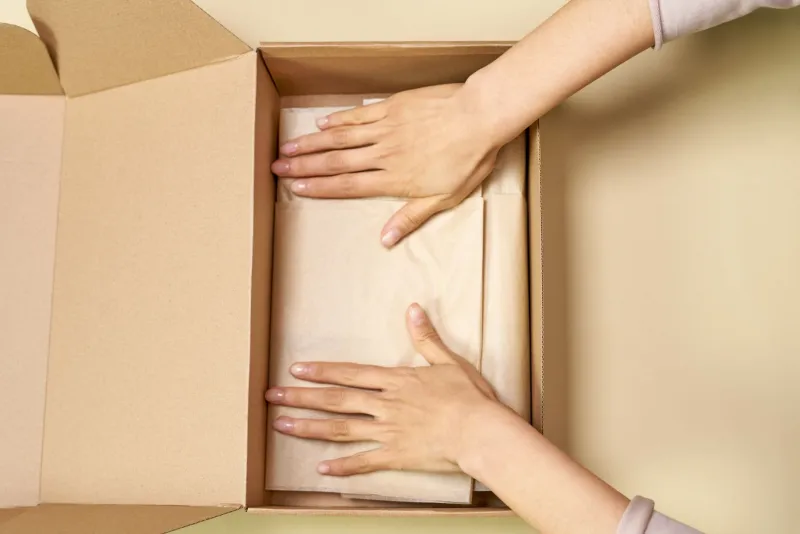
Only after that comes presentation. Makers describe a quiet hierarchy: item safe, box strong, contents tidy, then something extra if the budget allows. That extra might be a strip of tissue paper, a sticker seal, a handwritten thank-you card or a snippet of ribbon. None of it is compulsory. All of it costs money and time.
The mistake shoppers make is assuming a plain outer box means a careless maker. Sometimes the opposite is true. A plain double-walled box with proper internal bracing can be a better sign than a pretty mailer that lets a heavy item rattle about. Presentation should never be judged separately from protection.
Pretty versus protected: the compromise every maker prices
Packaging has a postage bill attached. In the UK, a few centimetres can move a parcel into a different size band, and a few grams can matter at the counter. A maker who adds a rigid gift box, tissue, a card and a fabric bag may create something lovely to open — and something more expensive to send.
Some absorb that cost. Some pass it on. Some offer a choice: basic postal packaging or a gift-ready upgrade. None of those approaches is automatically wrong, but the listing should be clear. If a shopper pays for gift wrap, they should get more than a folded sheet of tissue. If they do not pay for it, they should not expect a boutique unboxing.
The fairest question is not whether the parcel looks expensive. It is whether the packaging matches what was promised. A maker who says the item will arrive in a simple protective box and does exactly that has kept their side of the bargain.
The recyclability question is not as simple as it looks
Recycling is where packaging gets genuinely tricky. Paper tape sounds good until you realise some councils do not want it on cardboard. Compostable mailers sound better until you discover they need a commercial facility that your kerbside collection does not have. Tissue paper is often recycled, but not always, and glitter or metallic finishes can rule it out.
Makers are caught between what customers want, what couriers can handle and what local authorities will accept. Many now use paper tape, recycled cardboard boxes and paper cushioning where it is practical. Others stick with bubble wrap for fragile pieces because a broken gift is worse than a guilty conscience.
Shoppers can help by reading the maker's packaging note, if there is one, and checking their own council's rules rather than guessing. The symbol on the box is a starting point, not a promise. And if a parcel arrives with mixed materials, it is fine to separate what you can and bin the rest without writing a stern review about it.
When a parcel arrives damaged
Damage happens. Couriers are not gentle, and no maker can control what happens after a box leaves the studio. What matters is how the packaging was designed and how the maker responds.
Good packaging uses internal space well. It stops contents moving, protects corners and keeps sharp edges away from the outer wall. It also opens without a fight. A box that requires scissors, swearing and a risk assessment has failed at least one part of its job.
If something arrives broken, photograph the parcel before you unpack it fully, keep the packaging and contact the maker promptly. Most will ask for those photos because they need them for a courier claim. Judging a maker on one damaged parcel is fair only if the packaging was clearly inadequate or the response was poor.
What to keep, reuse and let go
Not every box needs to be kept. But a sturdy gift box, a clean cotton bag, a ribbon without creases or a tissue-lined inner box can have a second life. Use them for your own gifting, storage or craft projects. Reuse is usually better than recycling, as long as you are not turning your spare room into a parcel museum.
Let go of the rest without guilt. Packaging is there to do a job, not to become a permanent collection. The gift is the thing with the name on it.
A shopper's short checklist for 2026
When the parcel arrives, ask a few simple questions. Did it protect the item? Was it easy to open without damaging what was inside? Could the main materials be reused or recycled where you live? Did the maker tell you what to expect?
If the answers are mostly yes, the packaging has earned its postage. If the box was plain but the mug arrived whole, that is not a failure. If the parcel was beautiful but the gift inside was rattling, that is worth mentioning. The box is part of the gift, but it is not the whole story.